Monday, February 4, 2013

Looking for Maltese Records in France?

French Genealogical Records

France is divided in 95 administrative divisions called departments. Each department has its own archives which is separate from the National Archives (Archives Nationales).
The genealogical records you need to trace your French ancestors are kept at these Departmental Archives (Archives Départementales) and in local town halls where they are called Municipal Archives (Archives Municipales).

The Parish Registers (Registres paroissiaux)
Same Topic :


In 1539, King Francis I of France ordered the general keeping of baptismal and burial registers. The marriage registers have been introduced in 1579.
The Parish Registers are kept at the Departmental Archives.
The contents have changed over time but here are the information you can expect to find:
Baptism:
  • Date of baptism
  • Child’s first name
  • Date and place of birth
  • Father’s surname, first name and occupation
  • Mother’s maiden name, first name and occupation
  • Godparents
Marriage:
  • Date of marriage
    • Spouses
    • Surname and first name
    • Age
    • Where born
    • Occupation
    • Place of residence
    • Parents
    • Wether divorced, widow or widower
  • Witnesses
Burial:
  • Date of burial
  • Surname, first name, age and occupation of the deceased
  • Date and place of death
  • Cause of death
  • Witnesses
The Civil Registers (Registres d’état civil)
In 1792, during the French Revolution, the Legislative Assembly has introduced the Civil Registers for the general keeping of birth, marriage and death records but the Parish Registers are still in use for the Catholics.
The Civil Registers are kept at the local town halls and a copy is send to the Departmental Archives after 100 years.
Here are the information you can expect to find in the Civil Registers:
Birth:
  • Date and time of bitrh
  • Child’s first name and sex
  • Father’s surname, first name, age, occupation and place of residence
  • Mother’s maiden name, first name, age, occupation and place of residence
  • Godparents and declarants
Marriage:
  • Date of marriage
  • Spouses
  • Surname and first name
  • Age
  • Where born
  • Occupation
  • Place of residence
  • Parents
  • Wether divorced, widow or widower
  • Witnesses and declarants
Death:
  • Date and time of death
  • Place of death
  • Cause of death
  • Surname, first name, age and occupation of the deceased
  • Wether infant, bachelor or spinster, married, divorced, widow or widower
  • Declarants
The Decennial Tables (Tables décennales)
The Decennial Tables are a ten-year alphabetical index of all births, marriages and deaths recorded in the Civil Registers. They are very useful to quickly search for a person.
The Decennial Tables are kept at the local town halls and a copy is send to the Departmental Archives after 100 years.
Here are the information you can expect to find in the Decennial Tables:
Birth:
  • Date of registration
  • Child’s surname and first name
Marriage:
  • Date of registration
  • Surname and first name of the spouses
Death:
  • Date of registration
  • Surname and first name of the deceased
The Censuses (Recensements)
The French Censuses have been held in 1831, 1836, 1841, 1846, 1851, 1856, 1861, 1866, 1872, 1876, 1881, 1886, 1891, 1896, 1901, 1906, 1911, 1921, 1926, 1931, 1936, 1946, 1954, 1962, 1968 and 1975.
Here are the information you can expect to find in the Censuses:
  • Street name and number
  • Name and first name
  • Age
  • Sex
  • Rank
  • Occupation
  • Wether infant, bachelor or spinster, married, divorced, widow or widower
  • Nationality

Saturday, February 2, 2013

Napoleon Bonaparte and MALTA (1798 - 1800)

                                               http://www.napoleonguide.com/malta.htm


Malta

1798 and 1800

The island of Malta was an important strategic stronghold in the Mediterraenean Sea and Napoleon Bonaparte knew that controlling it would boost France's naval capacity in the region.
It would also help secure the supply lines of his expedition toEgypt and so when the French fleet arrived off Malta on 9 June, Napoleon's plan was to find an excuse to wrest it from the control of the Order of St John.

The religious order's leader, the Grand Master Baron Hompesch, was leery of a request to sail the entire French fleet into Malta's Grand Harbour and refused Napoleon's approach to take on new water supplies unless the French limited their operations to four vessels at a time.

The French commander used the rejection as an excuse for hostilities and sent armed forces in to occupy key military positions and isolate the fortress of Valetta.

Hompesch proved too indecisive to take on the determined Napoleon and while local Maltese forces offered to resist the occupation the Grand Master lacked resolve and submitted with little resistance.
Only three Frenchmen lost their lives in the takeover.

For the next five days Napoleon reorganised Malta's administration, inaugurated a new education system, abolished slavery and gave religious freedom to the island's Jewish community. He also looted some six million francs from the Maltese treasury.

When he set sail for Egypt he left a 4000-man garrison behind to secure it the island.

Unfortunately, for the French, Admiral Horatio Nelson's victory at the Battle of the Nile ripped the naval balance into British hands and a blockade cut the French occupants of Malta off from reinforcements.
The British blockade proved to be unsustainable and when a strong French naval force moved into the Mediterraenean the garrison was strengthened by 1500 troops and command handed over to General Pigot.

By mid-1800, the British landed 2500 troops and together with some 4000 local militia they increased pressure on the French.

With his supply position worsening, the new French Commander held out for three months before agreeing to surrender the island in exchange for free evacuation to France.

Victory over the French forces did not immediately secure Malta for Britain as the Order of St John and Russia both made determined efforts to control the island.

Eventually, neither succeeded.

Friday, January 11, 2013

Speaking Maltese - Lesson 6 - Days and Months


This is the 6th video clip of "Speaking Maltese" and its about days,months,seasons and some festive greetings.  Hope you'll enjoy it and find it useful.

http://youtu.be/inndfInYFS0

Sunday, January 6, 2013

Speaking Maltese - The Clock


http://youtu.be/dB1yGrqbnIA
this is the 5th video clip of speak maltese and its about the clock , it tells you how to say or to tell time in maltese , i hope you will fined it use full like the other "speak maltese " video clips .


Thursday, January 3, 2013

Speak Maltese - Numbers


Numbers


http://youtu.be/d556rxtZy8o

This is my 4th video clip for Speaking Maltese!  This video clip shows how to say Numbers in Maltese, 
Please don't hasitate to leave any comments or suggetions, and dont forget to rate this video!! Thank you


Tuesday, December 18, 2012

"Bride of Mosta" sung by Frans Baldacchino


Uploaded on Oct 28, 2010
L-Gharusa tall-Mosta (The Bride of Mosta), a legendary story about the Bride of Mosta sung by Frans Baldacchino (Il-Budaj).

Photos of Frans and of the Garden of the Bride of Mosta by Choy Hong (Jasmine) Grech.

http://youtu.be/5cHK4vRfSo8

Saturday, December 8, 2012

Speaking Maltese - Lesson 3 - Personal Pronouns and the Negative.


Uploaded on Feb 20, 2010

This is my third video clip of "Speaking Maltese" showing you some personal pronouns and the
Negative!  Make sure you watch the other second clip of "Speaking Maltese" which are " the alphabet" and " basic expressions." Please don't hesitate to leave any comments or suggetions.

http://youtu.be/nWCOMqgCB-U

Friday, December 7, 2012

Speaking Maltese - Lesson 2 - Basic Expressions


TheHuSkY1984  Uploaded on Jan 21, 2010
This second video clip of Speaking Maltese is about some basic expressions. I will add more videos if I get good responses.  Please leave any comments and any suggestions.  They are all welcome.

Monday, November 19, 2012

Speaking Maltese - Lesson 1 - Maltese Pronounciation

Maltese (Malti)


Maltese is a Central Semitic language spoken by about 350,000 people on the Mediterranean islands of Malta and Gozo. The Maltese language developed from the Siculo-Arabic or Sicilian Arabic, a form of Arabic that developed in Sicily and Malta between the 9th and 14th centuries. Siculo-Arabic was extinct in Sicily by about 1300, but continued to be spoken in Malta and evolved into Maltese. The first reference to Malta having a distinct language dates from 1364, and the language is first referred to as lingua maltensi in the will of a certain Pawlu Peregrino from 1436.

There is also a theory that Maltese developed from Carthaginian or Punic, the language of Carthage, which was a form of Phoenician. This theory was endorsed by Giacomo Bosio in his book, Dell'Istoria della Sacra Religione et Illustrissima Militia di San Giovanni Gierosolimitano (The History of the Sacred Religion and Illustrious Militia of St John of Jerusalem), written between 1594 and 1602. As Carthaginian and Arabic are both Semitic languages that developed from the same roots, it is difficult to be sure whether Maltese words arrived via Carthaginian or Arabic.
The first known literary text in Maltese, II Cantilena, appeared during the 15th century, the first Maltese dicitonary was published in 1649.

As well as the Arabs who began taking over Malta in 870 AD, Malta was occupied by Norman-speaking Normans from 1090, and between 1530 and 1798 by the Knights Hospitaller of St John who spoke French, Spanish, Italian, Portuguese, Latin and German. In 1800 Malta became a British colony and the British tried to replace Italian with English as the local language. As a result, about half of the vocabulary of Maltese comes from Sicilian and Italian, and a fifth comes from English. Maltese also contains quite a bit of vocabulary from Norman and French.

After Malta become independent in 1964 both English and Maltese were given official status and Maltese became the national language of Malta. Today Maltese is used in most sectors of public life, including parliament, the church, the press and other media, and in general conversation. English is generally the preferred medium of instruction in schools, especially at the higher levels of the educational system.


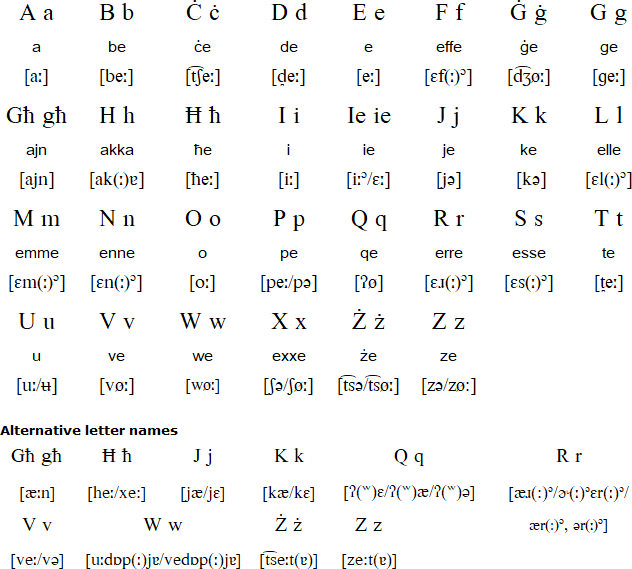
Maltese alphabet  
A a B bĊ ċ  D d  E e  F fĠ ġG g    Għ għ H h
a  be  ċe  de  e  ef   ġe ge    ajn   akka
Ħ ħI i  Ie ie J j  K k L l M mN n O oP p
ħe  i  ie  je  ke  elle   emme enne    o   pe
Q q R rS s T t U u  V v W wX x Ż żZ z
qe  erre  esse  te  u  ve   we exxe    że  ze

A recording of the Maltese alphabet  FROM
http://www.youtube.com/user/TheHuSkY1984


Maltese pronunciation

Maltese pronunciation

Notes

  • is silent but pharyngealizes and lengthens vowels
  • h has a simliar function to
  • and h at the end of a word are both pronounced as ħ
  • għh = ħħ
  • Final consonants are devoiced: b = [p], d = [t], ġ = [ʧ], g = [k], v = [f], ż = [s]
  • i before għ, h, ħ or q = [iː]
  • m followed by a consonant at the beginning of a word is pronounced im, e.g. mnejn = [imnejn]

Sunday, November 18, 2012

Coastal Towers of the Knights of Malta (Part 2)


This is the second part of the series about coastal towers erected by the Knights of Malta. The first part dealt with the towers built during the reign of Grand Masters Wignacourt and Lascaris. 1658-59 saw the construction of Grand Master Martino De Redin's famous set of 13 coastal watch-towers that were designed to send early warning signals along Malta's coast to Valletta. De Redin completed the set in 1660 with the tower at Mġarr ix-Xini on Gozo's southern coast. See also Ta' Sopu Tower built by Grand Master Cottoner in 1667 in the vicinity of San Blas and Daħlet Qorrot in Gozo.

Music by Arthur Sullivan: Macbeth Overture, Cello Concerto 3rd Movement (extract).

Posted on You Tube by http://youtu.be/-oY-cSBqLgk

Saturday, November 17, 2012

Coastal Towers of the Knights of Malta (Part 1)


A tour of the towers erected around the coasts of Malta and Gozo by Grand Masters Wignacourt and Lascaris during the period 1609 to 1652. Wignacourt's towers are massive structures that were armed with heavy artillery and strong garrisons. By contrast, Lascaris's towers were smaller affairs that served mostly as watchtowers (one notable exception being St. Agatha's Tower, or Red Tower, in Mellieħa that guarded the Malta/Comino channel as well as Għadira Bay). Lascaris's towers were the predecessors for De Redin's towers that were used to send early warning signals along Malta's coast to Valletta. De Redin's towers are featured in Part 2.


Video provided by http://youtu.be/Kijap5L8pbg

Friday, November 16, 2012

THANK YOU - Archdiocese of Malta for Digitizing the Maltese Microfilms !!!!


From Microfilms to Digital Media


The Hill Museum & Manuscript Library began microfilming the archival collections of the Cathedral of Mdina, Malta, in 1973 under the direction of Mgr John Azzopardi. Filming concluded in 1989 after 8,229 books and manuscripts had been filmed. The microfilming project at the cathedral also included books, music manuscripts, and archival materials from other ecclesiastical institutions and private collections in Malta and Gozo. The contents of the materials filmed date from the eleventh to the twentieth century.
Among the various manuscripts microfilmed in Malta we find the Archives of the Archbishop's Curia in Floriana.

The Archives of the Archbishop of Malta, located in Floriana, contain the diocesan records from 1531 to 1898, along with some miscellaneous items dating from 1450 to 1928. These documents are housed in Floriana.

The Archdiocese of Malta has transferred all its microfilms into digital media to make them available over the internet.  This will enable the Archives to be more reachable by researchers and the casual visitor alike. 
The Archives of the Archbishop of Malta hold more than is being published here.  Researchers and visitors are more than welcome to visit and do research at the Archives of the Archbishop at the Archbishop's Curia in Floriana Malta.
This is an ongoing project and the Archdiocese of Malta is still digitizing Manuscripts found especially in the Mater Dei and Sancte Laurenti Archives.


Your way through this website

http://archives.maltadiocese.org/Home.aspx


Thursday, November 15, 2012

Australian Visit Oct/Nov 2012


Australia has never been better.  The Business Class over from 

Los Angeles was a perfect way to travel to Sydney, Australia.  

After a couple of glasses of wine and a good nights rest, I 

arrived in Sydney at 6 am.  I was, first off, and through 

customs and immigration.  I had a list a mile long of things I 

wanted to do and didn't waste any time.

Thursday, September 13, 2012

How Many Maltese in Australia?


For a long time, the generally accepted figure was 400,000 which always carried the qualifier: "if descendants are included." Then in 1986, for the first time, the Australian Census asked a question about peoples ancestries. Thus, for the first time in Australia's 75 years of national census collecting, it was possible to accurately estimate Maltese ethnic strength.


Prior to the 1986 Census, the only ethnic data available related to birthplaces and languages other than English spoken at home. The latter was a useful guide to ethnic strength but, as the 1986 question on ancestries revealed, there are many more Australians who regard themselves as being of Maltese descent than who actually speak the Maltese language. The 1986 Census found that the figure of 400,000 was way off, a gross exaggeration. Some people in the community accepted the 400,000 figure. Why was that?  Basically, it was  accepted it because it came from what seemed to be reputable sources. The Australian Department of Immigration had established a History Unit in the early 1970s and, in 1974, the History Unit released a series of estimates of numerical strength of several ethnic communities. The estimate for the Maltese was 400,000. (click here to read more).

Wednesday, September 12, 2012

Maltese in Australia


Maltese in Australia

Historical Background

The first Maltese arrived in Australia as convicts in 1810, followed by the first free settler in 1838. The first organised migrant group arrived in 1883 when 61 Maltese labourers were recruited to work on the sugar plantations in Queensland. Many of these migrants returned to Malta because of the harsh working conditions they experienced.

Maltese migration to Australia gradually gained momentum after 1905. The 1911 Australian Census reported 248 Malta-born residents. Between 1911 and 1919 a further 2000 migrated. The 1933 Census recorded 2782 Malta-born in Australia.

Immigration from Malta increased after 1944, when Maltese migrants were classified as 'white British subjects' for the purposes of Australia's immigration policy. (click here to read more)

Thursday, September 6, 2012

MALTA: Gzira, Ta' Xbiex, Msida & Pieta


This video can be found on You Tube. JasAlf5959 Channel. URL: http://youtu.be/26Qn5c_9ivY

Wednesday, September 5, 2012

The Case Against Karmnu (Carmelo) Psaila


 Karmnu Psaila was Maltese by birth and a British subject who 

traveled to Libya in 1921 to start and life with his wife Vittoria.  

He owned a barber shop in the shopping district of Suk el 

Turk in Tripoli.  Life was good for the fourteen years he lived 

in Tripoli until he started talking against Mussolini, 

the Italian ruler of Libya at the time.  

In the beginning of 1936, he was being observed by officers 

who later confirmed that every morning between 5:30 am to 

7, Psaila spent his time at the Café Italia, in the Piazza dell-

Orologio, reading the Italian newspapers among them the 

“Avvenire di Tripoli” and commenting unfavorably in public 

on every item of news, which had a ring of victory for the 

Fascist Italy.  Psaila, made the same comments to his clients and 

to the neighboring shopkeepers.  Psaila was in the habit of 

disparaging Italy and to make matters worse he continued to 

an increasing degree his inexplicable aversion to Italians.  Later 

having become aware that he was being watched, Psaila placed 

small notices on the mirrors of his shop requesting his clients 

not to speak of political matters.  Too little to late I suppose 

because soon after that he found himself before a special 

tribunal being accused of, in the time of war, spreading 

exaggerated and tendentious with the object of depressing the 

public spirit and engaged in activities likely to cause harm to 

the national, vilifying the Italian, making use of insulting 

expressions followed by acts of scorn.

There is no doubt in regard to his guilt.  All the witnesses were 

in the position to give evidence in detail regarding the facts.  

The fate of Psaila was made quite clear.  After 

deliberation, the Court found Psaila guilty for the crime of 

political defeatism.  He was sentenced to three years and eight 

months imprisonment.  The Court also ordered that Psaila, on 

the conclusion of his sentence, should be expelled from the 

territory of the State.  

Saturday, September 1, 2012

A Maltese Treasure .. Dom Mintoff (6 August 1916 – 20 August 2012)

Mourning Dear Dom - maltatoday.com.mt

James Debono

Blog Monday, August 27, 2012

Mourning Dear Dom

The collective mourning for Duminku Mintoff was also symptomatic of a legacy of the blind devotion to the leader he cultivated to challenge an oppressive status quo.

Former premier Dom Mintoff
by James Debono
Collective scenes of devotional mourning are often the hallmarks of authoritarian regimes seeking to reproduce themselves, churches or sects led by charismatic leaders aspiring to sainthood or the media hyped celebrity culture where funerals are part of a grand reality TV spectacle. Khomeini and Kim Yong Il's funerals belonged to the first type, Pope John Paul's "santo subito" funeral to the second and Lady Di's and Michael Jackson's funeral hysteria are examples of the third category.

That is not to say that western democratic societies are immune to such feelings but grief is mostly reserved to victims of tragic circumstances whose death was either untimely or violently terminated, irrespective of whether the protagonists are celebrities, royals, sportsmen or politicians.  In most cases the first three categories are more likely to be venerated. In itself this says a lot of societies where politicians have long lost their grip on the popular imagination.

In the case of Mintoff we were dealing with grief over the death of a frail 96 year old whose death was widely expected. So one would have expected less drama and more probing commentary. (click here to read more)

This Is So Me ... a Maltese Detective


I found this post on http://www.geneamusings.com/2012/09/saturday-night-genealogy-fun.html
 and wanted to share this because
THIS IS SO ME .................

I think that I am primarily a Hunter or Detective.  I love the hunt, I love helping others with their hunt, I often go off on hunting "trips" in historical records on Ancestry.com or FamilySearch.org just to see if I can find something for my own database, or someone else's.

I am also an Ancestor Finder for my own research - I do this type of "deep research" only for my own tree, though.

I am also a bit of a Gatherer and Ancestor Collector - I try to find the collateral lines in my tree and add that data to my database. .... double click to read more

Sunday, August 26, 2012

Leveraging the Power of "WE"


LEVERAGING THE POWER OF WE 

A Watershed Event in Discovering Where to Find Your Ancestors

The watershed genealogical event that we have been experiencing for quite some time now and another event it is sparking are ..  DIGITIZATION (millions of records being put online every day).

Census, Birth, Marriage, Death, Emigration, Immigration, Family bibles, Family Histories, Cemeteries, Court, Military Schools, Land, Religious, Tax, Occupational, Newspapers, Local Histories, Diaries, Funeral Home, Insurance, Obituaries …............. the list goes on and on.

There are so many records coming online so fast and really that presents a CHALLENGE! Which records should I search first? read on ....

Friday, August 17, 2012

An Important Week in Maltese History, Aug - 1942


14 August 1942: 3000 Men Unload Convoy

14AUG
MALTA WAR DIARY: OPERATION PEDESTAL - SANTA MARIJA – DAY BY DAY
OPERATION CERES UNDERWAY
Operation Ceres underway c IWM GM1475
3000 army personnel are now working night and day to unload the supplies delivered by the newly-arrived convoy.  All possible vehicles are engaged in the task, code-named ‘Operation Ceres’.  In addition, 1500 army personnel are still working on the aerodromes for servicing and refuelling aircraft, and repairing runways as required to keep Malta’s fighters in the air and protect the precious cargoes.
AIR RAIDS DAWN 14 AUGUST TO DAWN 15 AUGUST 1942
Weather  Fine; visibility 10-15 miles.
Dawn  Having spent the night in futile attempts to towOhio, Bramham, Penn and Rye are joined by Ledbury.  Further attempts to tow the sinking tanker are more successful, albeit very slow.  The ‘cortege’ is joined later bySpeedy and two Motor Launches from Malta.
AM Spitfires 185 Squadron Hal Far are scrambled on five occasions to patrol over the incoming shipping.  No enemy activity encountered.
0545-0650 hrs  Four Spitfires 229 Squadron Ta Qali on convoy patrol fly near to Linosa and see a tanker which opens fire on them: no damage.
0625-0750 hrs  Three Spitfires 229 Squadron on convoy patrol: no enemy aircraft sighted.
0630 hrs  ML 168 arrives in Malta with 68 convoy survivors on board.
0700-0825 hrs  Eight Spitfires 249 Squadron Ta Qali on shipping patrol: no enemy aircraft sighted.
0740-0845 hrs; 0805-0940 hrs  Four Spitfires 249 Squadron at a time on shipping patrol: nothing to report.
Ohio inched towards Malta
0830 hrs  Commander minesweepers reports sweepers in company with Bramham and Penn, with tanker Ohio in tow, very deep in the water and almost unmanageable.
0850-0905 hrs  Air raid alert.  Raid does not materialise.
0912-1300 hrs  A long series of almost constant air attacks on Force X by dive bombers, high level bombers, torpedo bombers and dropping of mines or circling torpedoes by low-flying aircraft.  JU 88s bombers near-miss HMS Kenya, causing a small fire in a boiler room.
0925-1100 hrs  Eight Spitfires 229 Squadron are airborne: four to act as cover for the oil tanker Ohio and escort, the remainder as cover for a merchant vessel; nothing to report.
1000-1125 hrs  Spitfires from Ta Qali patrol over the convoy.  F/Lt Swannick sights a JU 87 diving on the ships.  He fires a 2-3 second burst from 100 yards and sees hits on the starboard wing: claims damaged.
1120-1250 hrs; 1145-1320 hrs; 1210-1340 hrs  Four Spitfires 229/249 Squadrons airborne at a time on convoy patrol: nothing to report.
PM  Spitfires 185 Squadron Hal Far are scrambled on four occasions to patrol over the incoming tanker and naval escort: no enemy activity.
1225-1345 hrs; 1340-1440 hrs  Four Spitfires 229/249 Squadrons airborne at a time to provide cover to a merchant vessel: nothing to report.
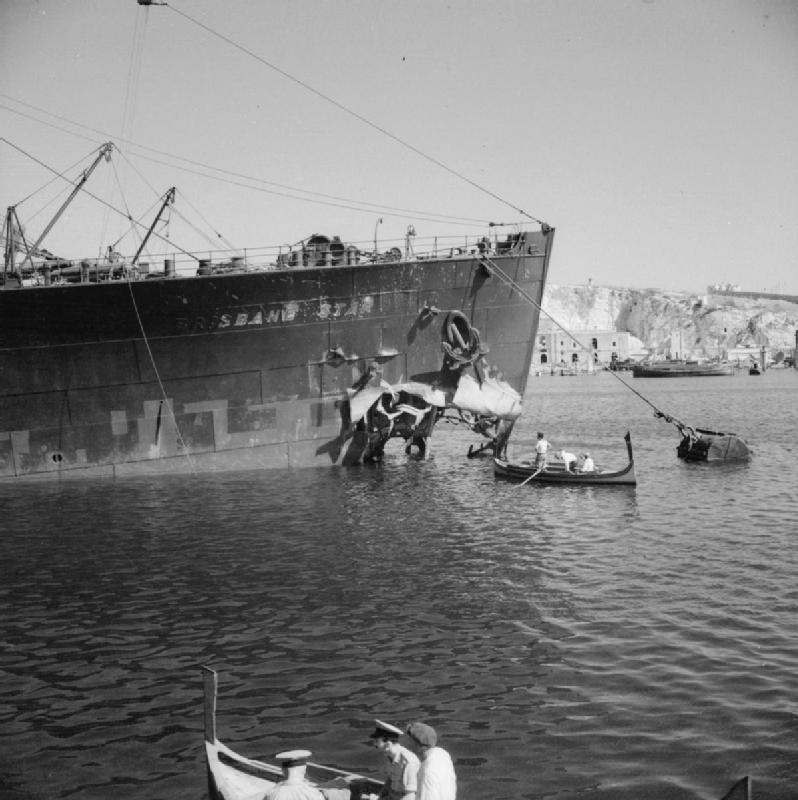
Damaged Brisbane Star in Grand Harbour
1415 hrs   MV Brisbane Star arrives in Grand Harbour, holed in her bows.
1450-1625 hrs  Four Spitfires 249 Squadron are airborne to act as escort covering the approach of the tanker Ohio.  One float plane and two fighters attack suspected raiders: no strikes are seen but target aircraft were later identified as friendly.  No warning had been issued by Fighter Control and the attacked aircraft did not give any warning that they were friendly until after they had been fired on.
1455-1610 hrs  Three Spitfires 249 Squadron escorting Ohioare diverted to intercept approaching enemy aircraft.  F/Sgt Parks sees one unidentified aircraft which he describes as twin-engined with a white upper surface and presumes is friendly.
1530-1550 hrs  Air raid alert for approaching enemy aircraft.  Twelve Spitfires 229 Squadron are scrambled to intercept: no sightings.
1550-1705 hrs;1725-1905 hrs; 1750-1925 hrs  Four Spitfires 229/249 Squadron at a time patrol over the tanker: no enemy aircraft sighted.
1800 hrs  Force X escapes the attacks unscathed joins Force Z: together they head for Gibraltar.
1820-1910 hrs  Air raid alert.  Twelve Spitfires are scrambled to intercept and sight six fighters but do not intercept.  Five minutes later three ME 109s appear and dive on Spitfires.  Sgt Hogarth is attacked from behind and bales out: he lands in the sea three miles off Zonqor and is rescued by HSL 128.  F/Sgt Hiskins scores cannon strikes on one ME 109 at 100 yards.  The Messerschmitt is last seen diving towards Grand Harbour, streaming black smoke.
1830-2035 hrs  One Albacore from Hal Far carries out an anti-submarine patrol over the incoming tanker.
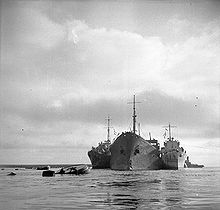
Ohio supported by Penn and Ledbury
1840 hrs  Ohio and the ships assisting her are within sight of Dingli.  In spite of frequent air attacks, during one of which the tow was parted by a bomb, and the great difficulty experienced in towing, slow but steady progress is bringing the tanker closer to Grand Harbour.
1915-2015 hrs  Four Spitfires 229 Squadron patrol over the tanker but are diverted several times to intercept enemy aircraft. Two aircraft return early.
2030-0040 hrs  One Swordfish from Hal FAr carries out an anti-submarine patrol over the incoming tanker.
2035-2110 hrs; 2205-2325 hrs  Air raid alert.
Night  After dark the presence of E-Boats was suspected and fire was opened by shore batteries on one occasion, but no results observed.
A total of seven enemy aircraft approach the coast.  Only two cross the coast, both of which are shot down by Malta night fighters: no bombs are dropped on land.  Bingemma Fort fires four rounds at a shipping plot 1000 yards west of Bingemma Battery.  Forts Madalena and Leonardo engage a shipping plot 12000 yards north east of St Elmo.  Four rounds are fired.  Searchlights expose but nothing is seen.
Military casualties  Nil.
Operation Pedestal casualties  CLICK HERE
Civilian casualties  Nil.
OPERATIONS REPORTS FRIDAY 14 AUGUST 1942
ROYAL NAVY  On reports of surface plots Coast Artillery Searchlight sweeps were carried out and star shell fired, but no enemy craft were sighted.
Brisbane Star entered Grand Harbour at 1430 hrs and Hythe and Hebe rejoined Commander M/S.  Continuous cover was given by fighter aircraft during the day, and together with the anti-aircraft protection afforded by the sweepers, succeeded in preventing the enemy from accomplishing his task of sinking Ohio and Brisbane Star.
Robust
Tug Robust was escorted to Marsaxlokk by Beryland Swona to stand by to assist with towing and was reported later to be towing ahead of Ohio. She proved, however, to be unsuitable for such a heavy tow and after bumping Penn and damaging her, she was not employed any more.  Flag Officer Commanding North Atlantic reported safe arrival of Force “Y”.  Fire was opened twice during the night on the information of RDF plots and it is considered that on each of these occasions E boats were driven off. The sound of engines was also heard and searchlights were switched on, but no targets were illuminated.
Since 0900 on 12th August, nine enemy aircraft were shot down by ships’ fire with eight probably and three possibly destroyed. The merchant vessels’ own anti-aircraft guns accounted for four of those definitely destroyed.
AIR HQ  Arrivals  One Beaufort from Gibraltar.  Departures  Three Hudsons to Gibraltar; two Wellingtons, one Spitfire to LG 224.  Aircraft casualties  One Spitfire shot down: pilot baled out uninjured.
FORTRESS ROYAL ENGINEERS  Bomb Disposal UXB  Reported 3.  Dealt with: 2 High Explosives (1 x 250kg; 1 x 50kg).

WELCOME!

Welcome to BACK to MALTA blog!

There are more Maltese outside the Maltese Islands than there are citizens residing in the country itself. The Maltese outside Malta are either emigrants or descendents of emigrants. The countries which have most traditionally hosted the Maltese diaspora are Australia, Canada, the U.S.A., and Britain. Nevertheless, there are Maltese living in virtually every country around the world and this blog will travel the world in hopes of bringing the Maltese back to Malta.

Total Pageviews