Sunday, August 26, 2012

Leveraging the Power of "WE"


LEVERAGING THE POWER OF WE 

A Watershed Event in Discovering Where to Find Your Ancestors

The watershed genealogical event that we have been experiencing for quite some time now and another event it is sparking are ..  DIGITIZATION (millions of records being put online every day).

Census, Birth, Marriage, Death, Emigration, Immigration, Family bibles, Family Histories, Cemeteries, Court, Military Schools, Land, Religious, Tax, Occupational, Newspapers, Local Histories, Diaries, Funeral Home, Insurance, Obituaries …............. the list goes on and on.

There are so many records coming online so fast and really that presents a CHALLENGE! Which records should I search first? read on ....

Friday, August 17, 2012

An Important Week in Maltese History, Aug - 1942


14 August 1942: 3000 Men Unload Convoy

14AUG
MALTA WAR DIARY: OPERATION PEDESTAL - SANTA MARIJA – DAY BY DAY
OPERATION CERES UNDERWAY
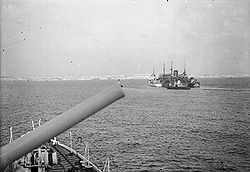
Operation Ceres underway c IWM GM1475
3000 army personnel are now working night and day to unload the supplies delivered by the newly-arrived convoy.  All possible vehicles are engaged in the task, code-named ‘Operation Ceres’.  In addition, 1500 army personnel are still working on the aerodromes for servicing and refuelling aircraft, and repairing runways as required to keep Malta’s fighters in the air and protect the precious cargoes.
AIR RAIDS DAWN 14 AUGUST TO DAWN 15 AUGUST 1942
Weather  Fine; visibility 10-15 miles.
Dawn  Having spent the night in futile attempts to towOhio, Bramham, Penn and Rye are joined by Ledbury.  Further attempts to tow the sinking tanker are more successful, albeit very slow.  The ‘cortege’ is joined later bySpeedy and two Motor Launches from Malta.
AM Spitfires 185 Squadron Hal Far are scrambled on five occasions to patrol over the incoming shipping.  No enemy activity encountered.
0545-0650 hrs  Four Spitfires 229 Squadron Ta Qali on convoy patrol fly near to Linosa and see a tanker which opens fire on them: no damage.
0625-0750 hrs  Three Spitfires 229 Squadron on convoy patrol: no enemy aircraft sighted.
0630 hrs  ML 168 arrives in Malta with 68 convoy survivors on board.
0700-0825 hrs  Eight Spitfires 249 Squadron Ta Qali on shipping patrol: no enemy aircraft sighted.
0740-0845 hrs; 0805-0940 hrs  Four Spitfires 249 Squadron at a time on shipping patrol: nothing to report.
Ohio inched towards Malta
0830 hrs  Commander minesweepers reports sweepers in company with Bramham and Penn, with tanker Ohio in tow, very deep in the water and almost unmanageable.
0850-0905 hrs  Air raid alert.  Raid does not materialise.
0912-1300 hrs  A long series of almost constant air attacks on Force X by dive bombers, high level bombers, torpedo bombers and dropping of mines or circling torpedoes by low-flying aircraft.  JU 88s bombers near-miss HMS Kenya, causing a small fire in a boiler room.
0925-1100 hrs  Eight Spitfires 229 Squadron are airborne: four to act as cover for the oil tanker Ohio and escort, the remainder as cover for a merchant vessel; nothing to report.
1000-1125 hrs  Spitfires from Ta Qali patrol over the convoy.  F/Lt Swannick sights a JU 87 diving on the ships.  He fires a 2-3 second burst from 100 yards and sees hits on the starboard wing: claims damaged.
1120-1250 hrs; 1145-1320 hrs; 1210-1340 hrs  Four Spitfires 229/249 Squadrons airborne at a time on convoy patrol: nothing to report.
PM  Spitfires 185 Squadron Hal Far are scrambled on four occasions to patrol over the incoming tanker and naval escort: no enemy activity.
1225-1345 hrs; 1340-1440 hrs  Four Spitfires 229/249 Squadrons airborne at a time to provide cover to a merchant vessel: nothing to report.
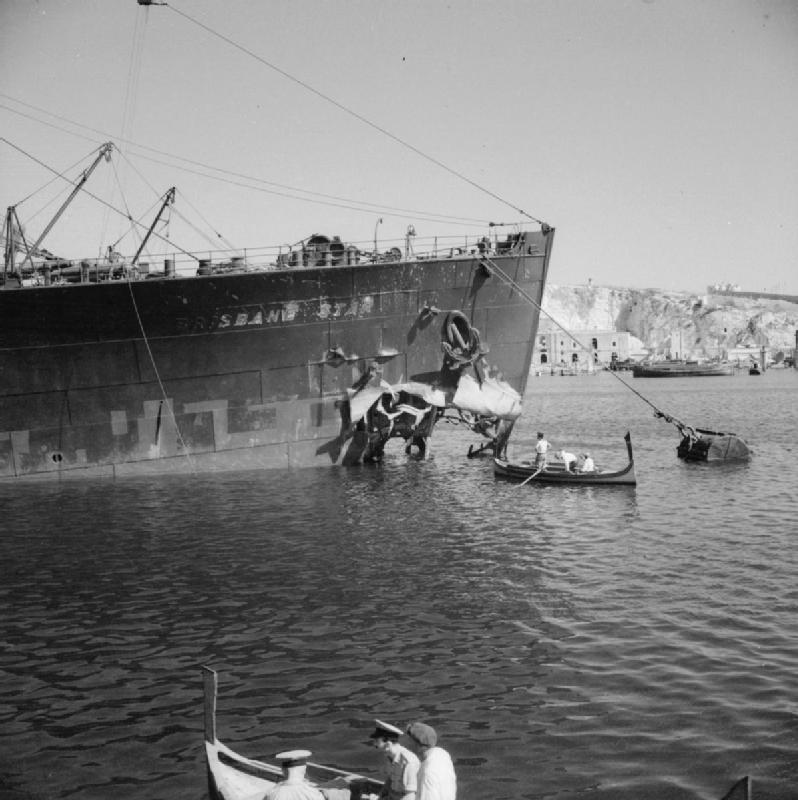
Damaged Brisbane Star in Grand Harbour
1415 hrs   MV Brisbane Star arrives in Grand Harbour, holed in her bows.
1450-1625 hrs  Four Spitfires 249 Squadron are airborne to act as escort covering the approach of the tanker Ohio.  One float plane and two fighters attack suspected raiders: no strikes are seen but target aircraft were later identified as friendly.  No warning had been issued by Fighter Control and the attacked aircraft did not give any warning that they were friendly until after they had been fired on.
1455-1610 hrs  Three Spitfires 249 Squadron escorting Ohioare diverted to intercept approaching enemy aircraft.  F/Sgt Parks sees one unidentified aircraft which he describes as twin-engined with a white upper surface and presumes is friendly.
1530-1550 hrs  Air raid alert for approaching enemy aircraft.  Twelve Spitfires 229 Squadron are scrambled to intercept: no sightings.
1550-1705 hrs;1725-1905 hrs; 1750-1925 hrs  Four Spitfires 229/249 Squadron at a time patrol over the tanker: no enemy aircraft sighted.
1800 hrs  Force X escapes the attacks unscathed joins Force Z: together they head for Gibraltar.
1820-1910 hrs  Air raid alert.  Twelve Spitfires are scrambled to intercept and sight six fighters but do not intercept.  Five minutes later three ME 109s appear and dive on Spitfires.  Sgt Hogarth is attacked from behind and bales out: he lands in the sea three miles off Zonqor and is rescued by HSL 128.  F/Sgt Hiskins scores cannon strikes on one ME 109 at 100 yards.  The Messerschmitt is last seen diving towards Grand Harbour, streaming black smoke.
1830-2035 hrs  One Albacore from Hal Far carries out an anti-submarine patrol over the incoming tanker.
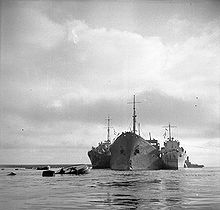
Ohio supported by Penn and Ledbury
1840 hrs  Ohio and the ships assisting her are within sight of Dingli.  In spite of frequent air attacks, during one of which the tow was parted by a bomb, and the great difficulty experienced in towing, slow but steady progress is bringing the tanker closer to Grand Harbour.
1915-2015 hrs  Four Spitfires 229 Squadron patrol over the tanker but are diverted several times to intercept enemy aircraft. Two aircraft return early.
2030-0040 hrs  One Swordfish from Hal FAr carries out an anti-submarine patrol over the incoming tanker.
2035-2110 hrs; 2205-2325 hrs  Air raid alert.
Night  After dark the presence of E-Boats was suspected and fire was opened by shore batteries on one occasion, but no results observed.
A total of seven enemy aircraft approach the coast.  Only two cross the coast, both of which are shot down by Malta night fighters: no bombs are dropped on land.  Bingemma Fort fires four rounds at a shipping plot 1000 yards west of Bingemma Battery.  Forts Madalena and Leonardo engage a shipping plot 12000 yards north east of St Elmo.  Four rounds are fired.  Searchlights expose but nothing is seen.
Military casualties  Nil.
Operation Pedestal casualties  CLICK HERE
Civilian casualties  Nil.
OPERATIONS REPORTS FRIDAY 14 AUGUST 1942
ROYAL NAVY  On reports of surface plots Coast Artillery Searchlight sweeps were carried out and star shell fired, but no enemy craft were sighted.
Brisbane Star entered Grand Harbour at 1430 hrs and Hythe and Hebe rejoined Commander M/S.  Continuous cover was given by fighter aircraft during the day, and together with the anti-aircraft protection afforded by the sweepers, succeeded in preventing the enemy from accomplishing his task of sinking Ohio and Brisbane Star.
Robust
Tug Robust was escorted to Marsaxlokk by Beryland Swona to stand by to assist with towing and was reported later to be towing ahead of Ohio. She proved, however, to be unsuitable for such a heavy tow and after bumping Penn and damaging her, she was not employed any more.  Flag Officer Commanding North Atlantic reported safe arrival of Force “Y”.  Fire was opened twice during the night on the information of RDF plots and it is considered that on each of these occasions E boats were driven off. The sound of engines was also heard and searchlights were switched on, but no targets were illuminated.
Since 0900 on 12th August, nine enemy aircraft were shot down by ships’ fire with eight probably and three possibly destroyed. The merchant vessels’ own anti-aircraft guns accounted for four of those definitely destroyed.
AIR HQ  Arrivals  One Beaufort from Gibraltar.  Departures  Three Hudsons to Gibraltar; two Wellingtons, one Spitfire to LG 224.  Aircraft casualties  One Spitfire shot down: pilot baled out uninjured.
FORTRESS ROYAL ENGINEERS  Bomb Disposal UXB  Reported 3.  Dealt with: 2 High Explosives (1 x 250kg; 1 x 50kg).

Wednesday, August 15, 2012

Views of Malta in the 1930's

Uploaded by on Nov 11, 2010
A depiction of everyday life in Malta during the decade that preceded World War II.


http://youtu.be/rxnHkj_uMOA

Monday, August 13, 2012

Searching for the Family of Carmelo Psaila from Sliema / Msida, Malta


I have been doing Maltese genealogy for about 15 years on and off, and I must say I still love it.  Some say it is the rich man's hobby because of all the money you spend on research trips, documents, and certificates.  Although that may be true, I think it is more for the obsessed.  There must be a level of OCD going on for me because I just can't seem to get enough of it.  I find myself, at times, unable to put my research down.  I am always thinking about what I have and what I need and how I'm going to get the job done.  The racing thoughts go through my brain during the day and  night creating a level of anxiety.  What makes it all worthwhile is when I do find something.  That's when I get a huge sense of accomplishment.   I have a saying that "It's easy once you know where to look."  The problem, of course, is where to look.  The one thing that  calms me is writing down the To-Do lists or calling one of my fellow researchers and bouncing ideas back and forth with them. 

I have a large family that really doesn't quite know what to make of all this.  They don't understand my curiosity.  They like to see the results but don't care much about how much effort went into obtaining the documents, or how much trouble I went through to get that certain photo.  When asked I explain that genealogy is like a huge jigsaw puzzle.  You are always looking for that one piece that fits in with the rest of the puzzle.   They are clueless, but I don't mind.  I still love sharing the "golden nuggets" with them.  After all, what I find belongs to them too. 

One thing that I have learned is that you must allow the story to reveal itself to you.  Don't let the  so called "facts" fit the story. Allow the stories to fit the facts.  In other words -.  Let the truth unfold.   NEVER ASSUME!  That's hard to do especially when you have nowhere else to turn.   When you start guessing that's when it gets really confusing making it easy to make mistakes.  In genealogy, you have to have three documents from three different sources (i.e. birth, marriage, death) before you can be confident enough that you are on the right track.  There are so many variables that play into the research that really anything can turn for you at any time so ALWAYS stay with the clear facts.  The best examples I can give are the names.  You may think that it's as easy as putting a surname in a search engine but the Maltese had nicknames, and many of them don't even go by their real names at all.  They go by their nickname.  My father's nickname was Gabrieleen.  So, if I were to go to his old neighborhood and ask about a Carmelo Borg they probably would not know who I am asking about.  I won't be able to find anyone who knew him, but if you ask about "Gabrieleen" now that's a different story.  

So, with all my knowledge on how to do genealogy tucked away safely in my brain I have set out to find my father's family.  There is no bigger dream for me than to find my Psaila relatives, Carmelo Psaila, my grandfather and Giuseppe Psaila, my uncle.  You see, even though my father is a Borg his real surname should be Psaila.  In order to find my grandfather, I think it's best to ask around for information on "Tripoleen," his nickname.  The documents, of course, will be under the official name, but if I am to locate his family what I really need to do is go into the town of Sliema or Msida and ask about "Tripoleen" to see if anyone remembers him.   To read about Maltese nicknames please go to: http://www.aboutmalta.com/grazio/nicknames.html

I am yearning for the day that I meet the Psaila's.   Everyday, when I wake up, I say to myself  "Today is the day I will find my Psaila family."  That may sound silly to some but for me; it is the best way I know to have the universe bring them to me.  I would tell them all about my father and our family.  I would listen intently to all of their stories, gathering more clues, of course.   After we exchanged the stories, I would show all the pictures and movies of my family.  We would exchange addresses and phone numbers, and we would stay in contact for ever more.  I'm anxious to see their faces and hear their voices.  I want to touch them and hug them.  It will be one glorious day, that I am certain of. 

My uncle, Giuseppe Psaila, is my father's half-brother.  I know this because he is listed in my grandfather's will as the only legitimate son to Carmelo Psaila and Vittorina Zammit.  He is the person of interest, at the moment, because I think, I have the best shot of finding him first.  I know he was born 27 Sep 1924 in Tripoli, Libya, but I don't know if he ever made it back to Malta or not.  His father did ....

Carmelo Psaila was already married to Vittorina Zammit when my father was born.  


Carmelo Psaila traveled to Tripoli to work, and Vittorina soon followed.  That was in 1921.  Libya, for some time, was under Italian rule.  Italian colonization (1911-1934) then Italian Libya (1934-1943).  Sometime in the thirties, Carmelo Psaila, spoke against Mussolini and ended up a political prisoner.  He was sentenced to six months in jail.  At the end of his prison term the Libyan government took his passport and put in on a boat back to Malta.  From all of my searching that's about all I know about him.

The challenge, of course, is to fill in the blanks.  I have another saying that genealogy without the stories are like a tree without any leaves.  So, it's important to me to try to find the story; the stories that would color my world.  The real stories about our lives are always going to be better than anything you can make up, right?

So, whenever you are trying to find the stories, you will have questions, and I have a lot of questions.  A lot of this don't make sense to me because I have no idea what happened my grandfather or his family.  I wonder what he went through as a prisoner.  Where were his parents, brothers and sisters?  Did they suffer the same fate?  Where is his wife Vittorina and Giuseppe now?   Did they stay in Libya or did they go back to Malta too?   These questions still linger.   

MaltaMade@gmail.com

Friday, July 27, 2012

The Gibraltar Explorer

 
The Gibraltar Explorer
he Gibraltar Explorer is a
project by Dr Larry Sawchuk that allows individuals interested in Gibraltar to explore its history using a computer based program. The most significant of the features is the ability to search the censuses of 1878, 1791 and 1777 for possible genealogical information. The Gibraltar Explorer is
available for download free of charge.To download the Gibraltar Explorer and for more information please go to: 
 http://www.utsc.utoronto.ca/~sawchukl/genealogy/

Thursday, July 26, 2012

Peter Paul Buttigieg's Gibraltar Family


Well, calling didn't work.  Out of the 19 numbers I could only speak to 3 two of which could not speak english.  Once I started talking I was o.k. because the people I spoke to were really nice.  I got nowhere though so today I'm going to try and get ahold of the National Archives and the person in charge Dennis Beiso.  He is a very helpful man and also very busy.  I believe he can easily track the Buttigieg's as I have the date of arrival.  My Peter Paul Buttigieg family came to Gibraltar in May of 1889.  It's fairly easy to locate the relatives 100 years ago because alot of records are available through the LDS church in Salt Lake City, Utah (see below) but finding the living is another story. 


The LDS hold microfilms of the following records, which can be ordered and viewed at one of their Family History Centres for a fee:


Church of England records


Bishop's transcripts for Gibraltar Anglican Chaplaincy, 1807-1812. Rites performed by Anglican clergy for British military stationed on Gibralter. (Outside the time period you're interested in though I know)


Roman Catholic


Parish registers, 1704-1991. These cover births, marriages and deaths for the following churches:


Catholic Church. Cathedral of St. Mary the Crowned (Gibraltar)
Catholic Church. Sacred Heart of Jesus (Gibraltar)
Catholic Church. Our Lady of Sorrows (Gibraltar)
Catholic Church. St. Theresa (Gibraltar)

Wednesday, July 25, 2012

Searching for the Maltese Family of Peter Paul Buttigieg in Gibraltar


Wednesday, the 25th of July, is the day I promised myself I was going to make all the necessary phone calls to Gibraltar in search of my Buttigieg line.  I have 19 phone numbers.  This is something I have never done before.  To call perfect strangers and say hey I think you're my relative is going to feel awkward.  My gg granduncle moved to Gibraltar in 1889.  I know that because I found his passport application leaving Malta.  Peter Paul Buttigieg is his name and he was born 1 Apr 1871.  He is the brother to my gg grandfather Bernard Borg.  If you are wondering how there could be two different names it will have to wait until I get all the facts down before I pass around theories.  I can assure you it is an interesting story amd that is the reason why I am calling all the Buttigieg's in Gibraltar.  They will have the actual story and once I learn the truth I will pass it on.   Wish me luck...

Monday, July 16, 2012

Malta ORBS

My father, before he died in 2009, told me he wanted to go back to Malta, where he was born. He was too sick to travel but always wanted to go back home.  Even though he carved out a life for himself in America, his heart never left Malta and he missed the sounds, smells and mostly the people of Malta.  He was born in Birkirkara and baptised at St. Elena parish.  He grew up there and as an adult lost his dear mother, grandfather and two daughters. 

He also had terrible memories of the war.  He was a Sapper in the Royal Engineers and remembered pulling out dismembered body parts out of the Opera House after it was bombed in WWII. 

 In the summer of 2010 I traveled to Malta with my father's ashes in my carry on luggage. I was amazed as to how easy it was to travel with the boxed ashes. I didn't inform the airline so not to draw attention to myself in fear of some respresentative taking the ashes from me so I kept my mouth shut.  I felt uneasy carrying his ashes around with me but felt I was on a mission.  Even though we never discussed where to place the ashes I wanted to do it for him.  I knew he would like that. 

After finding a special place to place the ashes I went into St. Elena parish church to say the rosary and pray for my father's soul to rest when I began to feel  motionless, unable to move.  At that moment I felt no control over my body and tears began to flow down my face. I had a sense as to what was happening to me and even though  I was frozen for a good while I allowed all the feelings to show.   I fell into the moment.  I was not aware of my surroundings as time slowed down.  It felt like a spirit in mourning was inside of me, using me as a vessel.  After awhile I slowly regained my composer, feeling exhausted and relieved.  I said  my final goodbyes.  My father was a good man and I was going to miss him.  And as I was leaving the church, I saw off in the distance, an orb at the front of the alter.  My father believed in spirits and saw orbs all the time. He welcomed them as he felt that what surrounded him was his beloved family. I knew he was with him that day.  I felt him.  He was happy to be home. 

Here are a few more instances where ghosts, or orbs if you will.

Manoel IslandThe apparition of the Black Knight, who seemed to spring out of nowhere, occurred during the years immediately following World War I, and was spotted by both Maltese and Englishmen working near a heap of rubble as part of the restoration of the island. Fort Manoel was a man-of-war and part of the reconstruction work being carried there at the time was to give back some sense of décor to the chapel.
Dressed in full armour and regalia of the Order of St John, the knight would be seen supervising the men’s work and his apparitions became more frequent once work there became more regular. The workmen also noticed the similarity between the Black Knight and a portrait of Grand Master Manoel de Vilhena himself by Favray which still hangs in the President’s Palace in Valletta.
When a crypt beneath the chapel was opened with the permission of the Archbishop, Captain Brockman, who was leading the work, found it had been destroyed by vandals. The altar and the reliefs bearing the crucifix and the souls in purgatory were all wrecked.
When the crypt was restored and masses were said, the knight stopped appearing. However, he came back. When investigations were once again carried out it was discovered that the crypt had been abandoned, only to be vandalised again. This was in 1980.

Verdala PalaceGrand Master De Verdalle left this palace for posterity and it was to be later connected with the story of the Blue Lady.
She was a young woman, a niece of Grand Master De Rohan for whom a suitor not to her liking had been chosen. Tired of being rejected by the lady in question, he imprisoned her in her room. One day she decided to escape through the window, only to fall out of it to her death. She was then seen roaming the building wearing a blue dress, the same dress she was said to have been wearing when she died. Between 1915 and 1919, Field Marshal Lord Methuen was governor of Malta. He was housing a guest – a certain Howard Jones – in the room, which had belonged to the Blue Lady. One day he asked the governor who the lady in blue, whom he always saw reflected in the mirror when he was dressing, was.
According to Mr Attard, the secret was out and there was no need for the governor to explain as most of the staff at the castle had also seen her.
Another weird manifestation, which may or may not be connected to the Blue Lady but which also occurred at Verdala Palace during Lord Methuen’s years of government occurred when the bishop of London was visiting the island. He failed to turn up on time for a dinner held in his honour much to the annoyance of the Governor who Mr Attard tells us was a “stickler for time”.
He turned up half an hour late. He explained that the reason for his tardiness was that he had “supernatural trouble” when his door opened by itself when he was about to leave, only to shut in his face, preventing him from going out. He was kept inside the room for half an hour and it was only when he recited the prayers of exorcism that it became possible for him to leave the room.

Fort St AngeloIt was at the time of the first governor of Siculo-Norman times, who was of Sicilian-Aragonese origins and a member of the family Di Nava, that the ghost of the Grey Lady came into being. She was one of the two women of Captain di Nava. Tired of being shared, she tried to protest only to be taken away by guards, killed and her body thrown in a cell in the fort’s dungeon.
She was seen and heard by both Maltese and English men. The children called her “the nice lady” and she was said to look very beautiful yet very sad. Others, however, found her to be very aggressive and vulgar as she banged and threw the furniture about. A Maltese lady decided to help the ghost by opting for solemn exorcism. The Grey Lady was never seen again.

The Grand Masters’ Palace Built by la Cassiere, this palace was one of the three residences of the British Governor. According to Mr Attard, an English lady who lived in the residence had been tormented by the sound of cats and dogs fighting in one of the rooms. When she went into the room to investigate, she discovered nothing. There was, however, an occasion when one of the ghosts appeared in the form of a large cat. She followed it to the window, and saw it jump outside in the yard where some men were working.
When she asked about the cat’s whereabouts, they couldn’t make out what she was referring to. They hadn’t seen any cat.


St John’s Co-CathedralA sexton working at the Co-Cathedral respected all the clergymen there, but there was a particular monsignor whom he respected most of all. The monsignor was very humble and carried out his duties without complaint. The sexton would serve him in his daily first Mass of the day, which he said at 5 a.m.
The sexton would open the church at 4.30 a.m., prepare the altar and go into the sacristy at 4.45 a.m., where he would meet the monsignor and they would chat while he helped him to don his vestments.
One day the monsignor arrived but there was no usual greeting. The monsignor was not talking. The sexton tried to make conversation yet the priest would not utter a word. Mass was said and when it was over they both returned to the sacristy. However, the priest remained reticent. Then as the monsignor was leaving he turned round to the sexton and told him: “See that you come here as usual tomorrow”.
As the sexton was making his way to the belfry he met the priest who celebrated the 6 a.m. Mass. He stopped him to tell him that there could not have been a 5 a.m. Mass since the monsignor had died suddenly the previous night. The sexton went cold and numb and recounted to the priest that there had indeed been a Mass yet the behaviour of the monsignor was quite suspicious and mysterious. The following day another priest met the sexton to say the 5 a.m. Mass. Suddenly the sexton heard the monsignor’s footsteps approaching. He walked in and both the clergyman and the sexton felt a barrier separating them from the monsignor. When the clergyman finally plucked up the courage and asked him why he was still with the living, the monsignor answered that he still had three Masses left unsaid when he died, and that this being the second one he would return on the morrow for the final time.
A similar event apparently happened at the Mdina Cathedral as well and even the church dedicated to the souls in Purgatory in Merchants Street, Valletta.
It was 1914 when Frank de Domenico, back then a young boy, had gone to check whether he had passed his entrance examination to the Junior Lyceum in Valletta. As soon as he walked out he was approached by a priest. Frank was immediately stunned by the face which he described as abnormal looking. It was sullen and sallow and the skin looked like it barely covered the skull. The priest asked the boy whether he had passed and when the boy replied in the affirmative, he asked him whether he could serve Mass. The boy once again replied in the positive. He then told him to follow him. Further down from the Lyceum in Merchants Street there is the small church dedicated to the souls in Purgatory. The boy followed the priest inside who told him to wait for him while he went to what the boy assumed to be the vestry to put on his robe and prepare for Mass.
The boy immediately realised that something was out of place. He seemed to have been waiting for ages so he decided to follow the footsteps of the priest, only to find that instead of a vestry there was an empty vault with no other openings, no windows and no apertures. Where had the priest gone?
Taken over by fear, Frank fled the place and couldn’t stop running until he caught the bus back home.

Haunted housesIt was during the time of the British rule in Malta when two drunken sailors were walking along the streets of Valetta, when upon reaching City Gate, they were accosted by a beautiful woman wearing the traditional Maltese costume, the għonnella. She asked them if they could accompany her home. Even though they didn’t feel like walking much, they assented partly because they felt fascinated by the beautiful lady. They followed her and when they reached the house in St Ursola Street, she asked them if they could help her inside as she had left the key inside.
The soldiers were bewildered by such a request but nonetheless decided to help out the mysterious lady. After some time one of the naval men managed to clamber inside where he found the key. According to Mr Attard, this should have set him thinking as at the time there were no Yale keys which could lock a house from the inside. When he managed to open the door for the lady and his friend, the lady took off her għonnella to reveal beautiful black locks. When she started to light the house, the splendour and richness of the house left them gaping. Now that they were in the company of a beautiful lady and in a magnificent setting, they felt more relaxed. However, as time drew nigh, they felt more weary and left the house. One of the sailors realised he had left a very expensive silver cigarette case inside the house and they decided they would call again on the morrow to get it. The next day they were shocked to find the same house in a very dilapidated state. They were told by one of the neighbours that the house was said to be haunted and that sometimes they could see the house lit from outside.
A similar event occurred concerning two ladies and a British gentleman. This story was published in Blackwood Magazine by a certain Lord Lorne who recounted how a friend of his met two ladies walking at an unholy hour at night and asked him to accompany them to their house. He found it most strange but curiosity overtook him. Again the house was magnificent and the garden was full of ripe orange trees. However, over the arch he noticed an inscription saying Omni Somnia meaning “Everything is a dream”. The following day, when he asked about the house, he was told that it had been uninhabited for about 100 years and it was said to be haunted by two sisters.
Another house said to be haunted in Valletta is that which belonged to La Vallette’s secretary, Oliver Starkey. Guests living in the house, which is now The Russian Cultural Centre, in 1990 said they were woken up at night by the sounds of cutlery and voices talking as if a banquet were taking place right in the living room. One of these guests was Elizavetta Zolina who was the director of the Russian Cultural Centre and who was staying in the house with her husband in 1993. A neighbour told off her husband because the parties they had been holding at their house were too noisy. It was then that Dr Zolina and her husband realised that what they were hearing at night was linked to the supernatural and the story was made public in The Times of September 10, 1996.
Do you have a story to share?

Saturday, July 7, 2012

Knights of St. John (2 of 6), Cyprus and Rhodes

Uploaded by on Sep 26, 2008
Documentary about the Knights of St. John, Cyprus & Rhodes


You can find this video on YouTube http://youtu.be/87s0yQKrioM

Friday, July 6, 2012

Knights of St. John (1 of 6) and The Crusades

Uploaded by on Sep 25, 2008
Documentary about the Knights of St. John & The Crusades


You can find this video on YouTube http://youtu.be/T3XM8E0qPP0

Saturday, June 30, 2012

MALTA: "The Three Villages" (3) - BALZAN


Video can also be seen on YouTube at http://youtu.be/gJA1-wGcWis

Uploaded by JasAlf5959 on Aug 8, 2009

"THE THREE VILLAGES" (3) - BALZAN

"The Three Villages" in Malta are made up of Lija, Attard and Balzan. This photo-video looks at Balzan's picturesque village, some historical buildings and its quaint narrow streets and alleys.

The Balzan motto is "Hortibus undique septa" (surrounded by gardens). Balzan is equally renowned for its orchards laden with the fresh scents of citrus fruits.

The earliest records of dwellings in Balzan date back to 1419. Balzan is now the home of 3900 inhabitants.

Balzan became a parish in 1655. The first parish church is still in existence. The present parish church was built in 1688, dedicated to the Annunciation of Our Lady. The titular statue shows Archangel Gabriel announcing to Mary. It was made of wood by Salv Dimech (Is-Sarc) in 1868.
There are two band clubs in Balzan - Mary the Annunciation Philharmonic Society established in 1890 as Circolo LAnnunziata and extended to became a band club in 1994. St. Gabriel Band Club established in 1920

Another prime organization is the Ghaqda Piroteknika 25 ta' Marzu which is responsibled for the beautiful fireworks.

The Youth Center of Balzan are volunteers who are very active in various activites including the folkloristic ones. There are also several religious organizations which provide education and assistance to their village people.

Thanks to Saviour Deguara and Daniel Muscat for their kind info and photos.

Photos by Choy Hong (Jasmine) Grech
Video by Alfred and Jasmine Grech, Mosta, Malta.

Thursday, June 28, 2012

MALTA: "THE THREE VILLAGES" (2) - ATTARD


Video can also be viewed at http://youtu.be/djcAqjTMQzY

Uploaded by on Aug 4, 2009

"THE THREE VILLAGES" (2) - ATTARD

"The Three Villages" in Malta are made up of Lija, Attard and Balzan. This photo-video looks at Attard's places of interest.

Onf of them is Ta' Qali which used to be a military aerodrome and a station for the RAF shortly after WWII.

Today, Ta' Qali is renowned for its recreational area, including sports and motor racing venue, whilst Ta' Qali Crafts Village is located within the old RAF barracks, offering varieties of souvenirs & crafts.

An Aviation Museum is found near the National Stadium and Malta Fairs & Conventions Center. In winter, a huge Sunday flea market is held at Ta' Qali.

Attard became a Parish in 1575 after it broke off from Birkirkara. By 1579, it had its first parish priest and the population then was 665 residents.

The Parish church is dedicated to the Assumption of Mary and was designed and built by Tommaso Dingli (1613-1616). A belfry was added in 1718 otherwise, the church is exactly what Dingli had built.

The titular statue of the Assumption of Mary was made in Paris in 1874.

Photos by Choy Hong (Jasmine) Grech
Video by Alfred & Jasmine Grech, Mosta, Malta

Wednesday, June 27, 2012

MALTA: "THE THREE VILLAGES" (1) - LIJA


Video can be found on YouTube -- http://youtu.be/vhrkbhNL5ec

Uploaded by on Aug 1, 2009
THE THREE VILLAGES (1) - LIJA

Lija has its origins in prehistory as is evident from the Megalithic tombs unearthed in 1967. However, the present village derives from the elevation to parochial status in the late 16th century. Residents amount to over three thousand.

Lija is best known for its oranges and citrus fruit, for its beautiful feast held on the 6th of August and for its famous pyrotechnics.

All Three Villages of Attard, Balzan and Lija, lay within the parish boundaries of Birkirkara. Like Attard and Balzan,

Lija is a quaint village with old, narrow, winding roads and contains numerous old, large country residences, many of which have seen a variety of historical events.

Villa Preziosi was used by the French troops during their invasion.

In 1837, a time when primary education was introduced in Malta, Lija was among the first to have its own school being situated in one of the large houses adjacent to San Anton Gardens.

Main Clubs of Lija are: Band Club Papa San Piju X - Sir Ugo Mifsud Street; St. Andrija Club - Bakery Street;
Saint Michaels Firework Factory and Ghaqda ta L-armar tal-Festi - Parish Church.

This is part one of the series, "The Three Villages" which lay in the centre of Malta.

Photos by Choy Hong (Jasmine) Grech
Video by Alfred & Jasmine Grech, Mosta, Malta

Thursday, June 21, 2012

In Memory of Frans Baldacchino (il-Budaj)

MALTA - BUDAJ (Frans Baldacchino) & ENZO GUSMAN

EXCERPT FROM "ENZO GUSMAN CONCERT" HELD DURING "ILJIELI MEDITERRANJI" ARGOTTI GARDENS, FLORIANA . AUGUST 1994


http://youtu.be/nMG_XRDHBM8

Bla Kommixin - Frans Baldacchino il Budaj

Festival ta Satira


Uploaded by on Sep 22, 2011 on YouTube http://youtu.be/iNqtbgTfHY4

My Choice - Frans Baldacchino (Il-Budaj): Tribute


A few photos depicting Frans Baldacchino (Il-Budaj), who was a very famous Maltese Folk Singer and who passed away in June 2006 at the age of 63. We'll see photos of Frans singing at the Razzett tal-Markiz in Mosta, the unveiling of Frans' bust at the same locationwhich bust was made by Malta's National Sculptor, Anton Agius, some of his paintings and artworks and the unveiling of his statue at San Girgor Garden in Zejtun, Malta. This statue was erected thanks to the initiative of Charles Mangion, Iz-Zubina, another famous folk singer and helped by John J Cassar who advertised and promoted this initiative on his www.allmalta.com website. All photos taken by Choy Hong (Jasmine) Grech.

We hear: Il-Gmiel tan-Natura (The Beauty of Nature) sung by Frans, In Memoriam composed by Frans' friend, Manuel Casha, a Maltese who lives in Melbourne Australia and L-Isbah Tfajla Maltija (The most beautiful Maltese Girl)

This is the tribute that Jasmine wrote and read during one of the ceremonies commemorating Frans Baldacchino known as Il-Budaj.

---------------------------------------------------------------
Il-Budaj, a legend of Malta

The Book of Ecclesiastes chapter 12 verse 7 says:
"Then shall the dust return to the earth where it came,
and the spirit shall return unto God who gave it."

Frans Baldacchino Il-Budaj returned to the Lord
Dressed in his best, he was carried into the House of God in Zejtun
Where he used to sing praises to the Lord, our God.

Placed before the altar, the awaiting heavenly Angels
Surrounded him with harps, flutes and a bay-leaf crown
To escort him to heaven through the snow-white clouds

A feast of love filled with hymns, prayers and tributes for his rest
Came from many eyes that wept and many hearts that were broken
Who moaned his demise, a great loss.

The many talents and dignity he possessed
Generously given, generously shared
Unlocked the treasures of this caring heart.

A pen in his hand turned into gold
With the magic words of love and praises he wrote
Sweetly flowed in the poems that he composed.

Painted with thousand words from his heart into an art
A brush he dipped in the shades of black or white
Came alive in colours and wonders on a canvas.

An enchanting voice he ghanna
Spred across the lands to the seven seas
Like the fragrance of red roses right before me.

He is sadly missed by many
But his ghana, poems, arts and novels
And the joy he brought us will never cease.

Frans, you missed l-Imnarja by a few days
But l-Imnarja will miss you for many years to come
You will always remain a legend of Malta

We thank God for you

Choy Hong (Jasmine) Grech

http://youtu.be/LHQ-Rwd-aao

Inhobbok ja Hanina - Frans Baldacchino il-Budaj.

Maltese folk singer, Frans Baldacchino, more popularly known as il-Budaj died at the age of 63 in 2006. His untimely death was undoubtedly affected many people who recognised the great talent and value that Frans Baldacchino possessed.

Il-Budaj began his love for folklore music at a young age, and was also passionate about opera and classical music. He loved writing poetry and was awarded a diploma a short while ago for his poetry by the group 'Poeti Maltin' of which he was a member. The much-loved singer participated in many folklore festivals, both on a local and international level, singing in Canada, France, Libya, Greece and Tunisia.

Frans Baldacchino earned himself the nickname il-Budaj in the 1950s, when the Hungarian football team Honved visited Malta. The players included Puskas and Bodai, whose name got passed on to Baldacchino's brother who also played football, and eventually was given to Frans.

Born in Zejtun on May 16, 1943, il-Budaj emigrated to Australia during the 60s where he formed part of a folklore group together with other Maltese emigrants. He returned to Malta in the 1970s.


Uploaded by on Jun 16, 2010
http://youtu.be/Piky6ONbT2Y

Wednesday, June 13, 2012

il-Karnival ta' Malta tas- sena 1928

I found this amazing video that I thought you would like because it gives a glimpse of what Malta looked like in 1928.  Let me know what you think.  Does it bring back any memories for you?

This is priceless! Around 45 seconds into the video watch out for the little girl in the background who almost 'beheads' a Grand Master with her enthusiastic flag-waving. Besides the obvious thrill of this film, also take in the costumes of the onlookers. The many 'ghonnellas' being worn near the theater. The theater looks magnificent, what a loss for our nation. So many theaters in Europe were destroyed and rebuilt, except ours!

You can find this video on YouTube (http://youtu.be/hwbjFH8AbUI)

Monday, June 11, 2012

MALTA Study Center

Photo: I'm glad you like the profile picture! It's a detail from an 18th-century watercolor showing the ships of the Knights of Malta attacking Algerian vessels off the coast of Spain in 1736. The original is one of an album of 18th-century maritime watercolors in the collection of the Malta Study Center.

(This is a detailed 18th-century watercolor showing the ships of the Knights of Malta attacking Algerian vessels off the coast of Spain in 1736. The original is one of an album of 18th-century maritime watercolors in the collection of the Malta Study Center.)


MALTA STUDY CENTER, COLLEGEVILLE, MINNESOTA, UNITED STATES OF AMERICA

Manuscripts, archives, Knights of St. John, Knights of Malta, Malta, Rhodes

Mission

To preserve the history of Malta and the Knights of St. John by sponsoring digitization projects, and to make that history available to researchers.

Company Overview

The Malta Study Center is an integral part of the Hill Museum & Manuscript Library, a non-profit organization whose mission is to preserve endangered manuscripts, make them accessible to researchers, and to teach about the cultures that produced them.

Description

The Center maintains a microfilm collection of more than 16,000 documents and dossiers of documents from Malta, covering the period of the twelfth to the twentieth century. The materials include the Archives of the Knights of Malta, the Cathedral Museum in Mdina, the Archives of the Inquisition, ecclesiastical records of the dioceses of Malta and Gozo, and musical compositions. The Center is currently working with the National Archives of Malta, the Notarial Archives of Malta, and the Magistral Library of the Sovereign Military Order of Malta in Rome.

General Information

Hill Museum & Manuscript Library
Saint John's University
Collegeville, MN 56321
www.hmml.org

Basic Info

Founded1973

LocationP. O. Box 7300, Collegeville, MN 56321-7300

Contact Info

Phone1 (320) 363-3993

Emailtvann@csbsju.edu

Websitehttp://www.hmml.org/centers/malta10/malt...

Friday, June 1, 2012

WELCOME!

Welcome to BACK to MALTA blog!

There are more Maltese outside the Maltese Islands than there are citizens residing in the country itself. The Maltese outside Malta are either emigrants or descendents of emigrants. The countries which have most traditionally hosted the Maltese diaspora are Australia, Canada, the U.S.A., and Britain. Nevertheless, there are Maltese living in virtually every country around the world and this blog will travel the world in hopes of bringing the Maltese back to Malta.

Total Pageviews